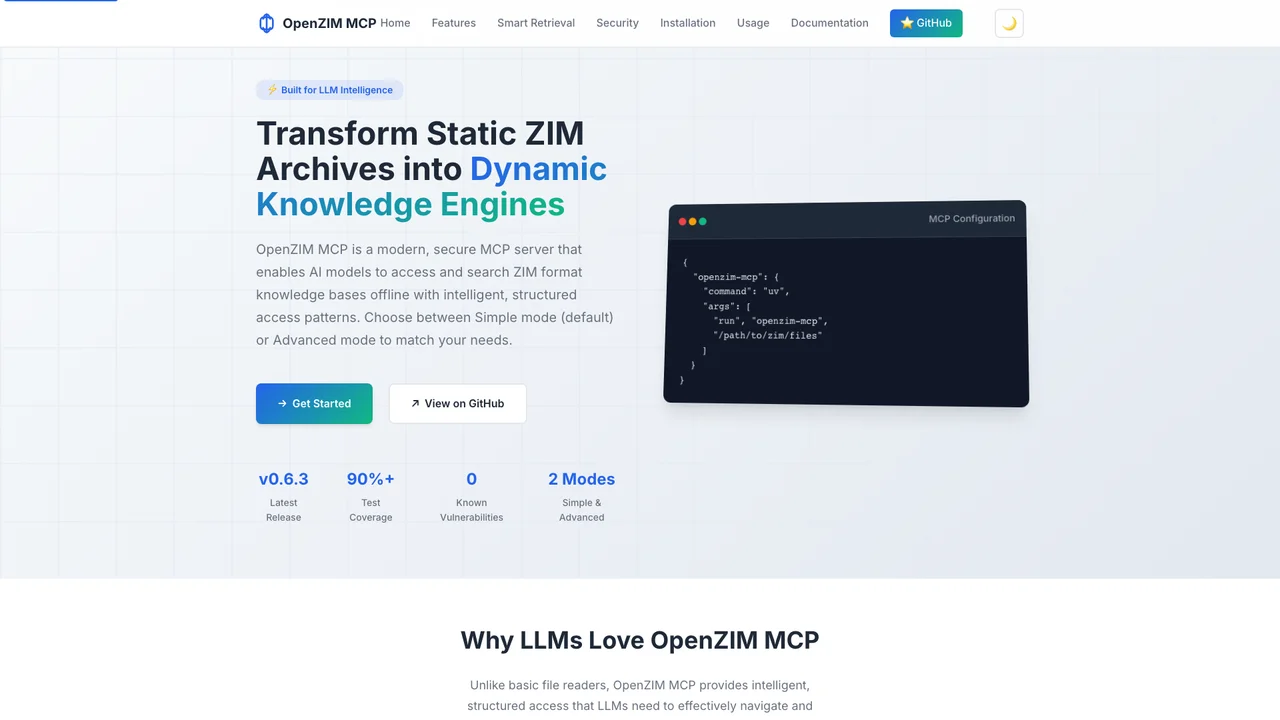

OpenZIM MCP is a modern, secure, and high-performance MCP server that enables AI models to access and search ZIM format knowledge bases offline. Perfect for accessing Wikipedia, Wikimedia projects, and other knowledge bases without internet connectivity.
MCP Tool Explorer
{
  "tool": "zim_search",
  "query": "quantum computing",
  "limit": 5
}Search for articles in the ZIM knowledge base
This is a simulated demo. The actual MCP server processes requests from AI assistants like Claude.
Key Features
- Offline Knowledge Access: Full Wikipedia and Kiwix content access without internet
- High Performance: Fast search across millions of articles
- Python-Based: Built with Python for easy deployment and extensibility
- MCP Integration: Standard Model Context Protocol interface
Why offline access mattered
Most AI tooling assumes an always-on network connection and a live API behind every retrieval request. That assumption breaks down in classrooms, field work, privacy-sensitive environments, and any air-gapped deployment. OpenZIM MCP was built to prove that high-quality retrieval can still feel immediate when the knowledge base lives on disk instead of behind a network hop.
Performance strategy
The project focused on a few pragmatic constraints:
- search should feel interactive even against multi-million-article archives
- article retrieval should return clean, model-friendly content instead of raw archival formats
- memory usage should stay low enough for modest developer machines and offline appliances
That drove the overall architecture: query the ZIM index efficiently, extract only the article payload that is needed, and normalize the result into an MCP response that is easy for an assistant to consume.
Product decisions
The strongest product decision was to make the server useful without requiring users to think about the details of the ZIM format. Developers care that the knowledge is offline and searchable; they do not want to learn an archive format first. MCP is a good fit here because it lets the complexity live at the boundary while the user gets a stable set of retrieval tools.
Outcome
This project demonstrates a theme I care about deeply: resilient software should not collapse the moment it loses access to the network. By pairing offline archives with an MCP interface, the server makes local knowledge bases feel like first-class infrastructure for AI systems instead of second-best fallbacks.
Was this helpful?
Want to learn more?
Ask can answer questions about this project's implementation, technologies, and more.